


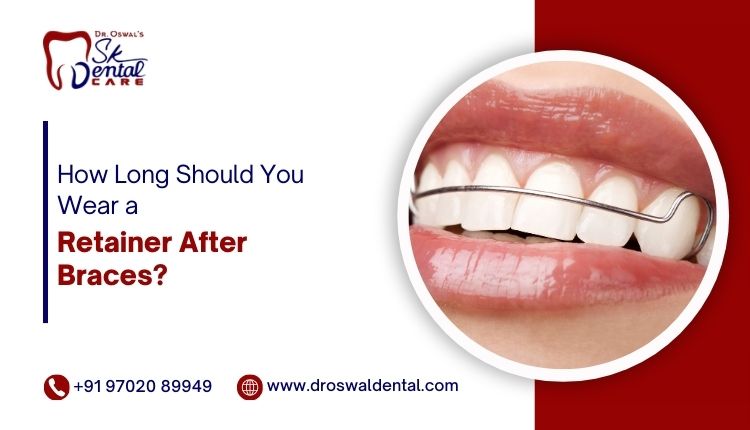
You finally see your straight smile in the mirror. Months or years of brackets, wires, food restrictions, and dental visits have paid off. The braces come off. You run your tongue across your teeth and feel that smooth, new alignment. It feels like graduation day.
And then your orthodontist hands you a retainer.
Most people smile politely at that point. Inside, they think, “Wait… I thought I was done.”
If you recently completed orthodontic treatment or plan to visit orthodontists for braces, you have probably asked this question silently: How long do I actually need to wear this thing? You want freedom, but you also do not want your teeth to shift back like an old mattress slowly losing shape.
At Dr. Oswal's S. K. Dental Care, we have an experienced team of orthodontists in Old Panvel. Patients feel excited about finishing braces, yet slightly confused about the next phase when they come in for treatments.
Let us walk through what really happens after braces and why that small, clear appliance matters more than most people expect.
Your teeth do not sit in bone like fixed pillars. They rest in a living structure supported by periodontal ligaments and surrounding bone. When braces move teeth, your body remodels that bone. It breaks down bone on one side and builds it on the other.
That process takes time. Even after your orthodontist removes the braces, the supporting structures remain in transition. Think of it like freshly set jelly. It looks firm, but if you shake the bowl too soon, it wobbles.
Without a retainer:
Orthodontists see this every day. They do not recommend retainers as a formality. They prescribe them because teeth have memory.
Retainers protect your investment. They hold teeth in their new positions while the bone stabilizes and the gums adapt. During the first few months after braces removal, this stability phase matters the most.
Orthodontists usually recommend:
At Dr. Oswal's S. K. Dental Care, orthodontists customize retainer instructions. They consider age, severity of original crowding, type of correction, and growth patterns. No two smiles follow the exact same timeline.
Patients often expect a simple number. Six months? One year? Two years?
The honest answer depends on biology and discipline.
Most orthodontists follow a phased approach:
Phase 1: Immediate Stabilization (First 3 to 6 Months)
You wear the retainer full-time. Your bone remodels and strengthens around the new tooth positions.
Phase 2: Transitional Phase (6 to 12 Months)
You switch to nighttime wear. Teeth feel more stable, but they still respond to pressure.
Phase 3: Long-Term Maintenance (Beyond 1 Year)
Many orthodontists recommend nighttime wear indefinitely. Yes, indefinitely. Not because something went wrong, but because teeth naturally shift with age.
Even people who never had braces experience subtle changes over time. Jaw growth, chewing patterns, and natural aging influence alignment. Wearing a retainer at night works like setting your phone to silent mode. You do not notice it, but it quietly prevents disruptions.
When you consult orthodontists in Old Panvel at Dr. Oswal’s S.K. Dental Clinic, they will likely explain this long-term maintenance concept in detail. It protects your smile for decades, not just months.
Life gets busy. People forget. Retainers sit in drawers or disappear during travel. At first, nothing feels different. Then one evening, the retainer feels tight.
That tightness sends a message. Your teeth have started to move.
If you stop wearing your retainer:
Orthodontic relapse does not happen overnight like flipping a switch. It creeps in quietly. Think of it like leaving a houseplant without water. One missed day does not show damage. Weeks of neglect change everything.
Not all retainers look the same. Orthodontists choose them based on clinical needs.
Removable Clear Retainers
These resemble clear aligners. They fit snugly over your teeth. They remain discreet and comfortable but require consistent wear and proper cleaning.
Hawley Retainers
These include a thin wire across the front teeth and an acrylic base. They allow slight adjustments and often last longer.
Fixed Retainers
Orthodontists bond a thin wire behind the front teeth. This option works well for lower incisors that tend to relapse. However, patients must maintain excellent oral hygiene to prevent plaque buildup.
Each type demands care. You should:
Your orthodontist monitors fit and stability during these reviews.
Children and teenagers often complete braces while still growing. Adults, however, have fully developed bone structures and stronger muscle patterns. These factors can increase the tendency for relapse.
Adults also juggle work stress, lifestyle habits, and less consistent routines. Skipping retainer wear becomes easier. That combination makes compliance crucial.
Many adults at Dr. Oswal's S. K. Dental Care share that nighttime retainer wear feels manageable once it becomes part of their routine, like applying moisturizer before bed. It does not demand much effort, yet it preserves results.
You should not ignore subtle changes. Contact your orthodontist if you notice:
Early correction prevents larger interventions. Orthodontic care works best when you address small shifts promptly rather than waiting until major misalignment occurs.
Orthodontists typically recommend full-time wear for the first few months after braces removal, followed by nighttime wear for long-term maintenance. Teeth continue to shift naturally due to aging and daily forces such as chewing. Consistent retainer use keeps alignment stable and prevents relapse. Most specialists advise wearing retainers at night indefinitely to maintain long-term results. Your orthodontist will personalize this plan based on your treatment history.
Yes, teeth can shift at any stage of life due to natural biological changes. Jaw growth, pressure from surrounding muscles, and daily habits influence tooth position over time. Even minor lapses in retainer wear can allow gradual movement. Regular follow-ups help monitor stability and detect early signs of relapse. Long-term use of a retainer offers the best protection against unwanted changes.
A tight retainer usually indicates minor tooth movement. You should not force it aggressively, as that can damage both the retainer and your teeth. Contact your orthodontist as soon as possible for evaluation. Early intervention may allow simple adjustments rather than new treatment. Timely action protects your orthodontic investment and prevents further shifting.
Yes, retainer wear remains a critical part of orthodontic treatment, not an optional step. Braces align teeth, but retainers maintain that alignment while the bone stabilizes. Without consistent retainer use, teeth may gradually return toward their original positions. Orthodontists emphasize retention because it ensures lasting results. Think of it as the maintenance phase that completes your orthodontic journey.
When people ask how long they should wear a retainer, they usually hope for a finish line. They want to mark a date on the calendar and move on.
But orthodontic care does not end when braces come off. It shifts into preservation mode. Wearing a retainer at night feels far less demanding than repeating months of active treatment.
Your smile reflects time, effort, and financial investment. A retainer protects all three.
If you plan to start or have recently completed braces, speak openly with orthodontists in Old Panvelabout your retention plan. Visit Dr. Oswal's S. K. Dental Care to understand what long-term stability means for your unique smile. A short conversation today can help you keep that confident smile exactly where it belongs for years to come.
© Copyright
S K Dental Care
All Rights Reserved. | Powered By 